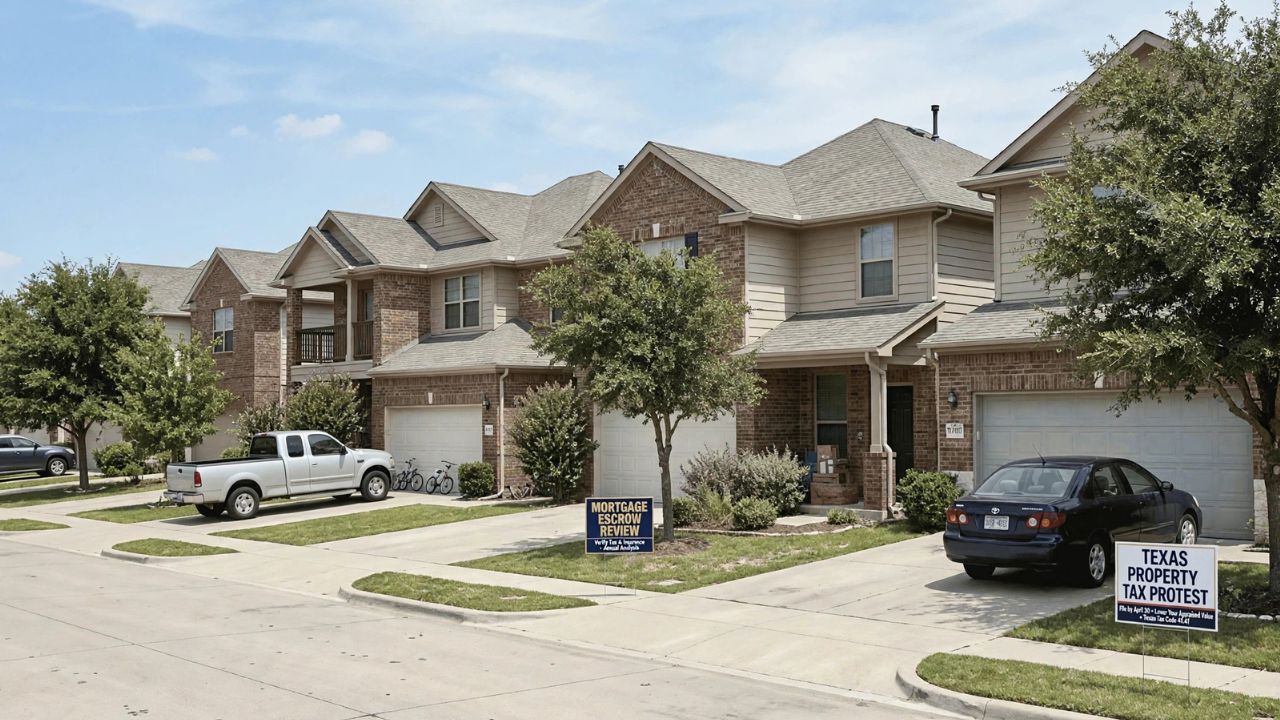
Texas Homeowners Can Win a Tax Protest and Still Wait for Escrow Relief
Texas – A Texas homeowner can successfully protest a property appraisal and still see the same mortgage payment for months afterward. The reason is that an appraisal protest, the final property-tax bill and a mortgage servicer’s escrow analysis are separate steps that do not necessarily happen at the same time.
A successful protest can reduce the value used to calculate property taxes, but it does not directly order a mortgage company to lower the homeowner’s escrow payment. Under federal mortgage escrow rules, servicers generally perform an escrow analysis at the end of each 12-month escrow computation year, although they are allowed to conduct one at other times.
That timing can create an awkward result: the homeowner knows the appraisal has been reduced, while the mortgage servicer may still be collecting money based on an earlier tax estimate.
Winning the Protest Is Only the First Step
Texas property owners have the right to protest an appraisal district’s value or certain other actions to the local appraisal review board, commonly called the ARB. If the ARB changes the value, it issues an order reflecting its decision. The Texas Comptroller’s protest guidance explains that the ARB can order the appraisal district to make changes based on the evidence presented.
But the appraisal district does not set the homeowner’s property-tax rate.
Texas property taxes are locally administered, and local taxing units such as school districts, cities, counties and special districts impose their own rates. The Texas Comptroller’s property-tax guidance explains that Texas does not impose a state property tax and that local property is taxed according to applicable appraised values, exemptions and local rules.
That distinction matters because reducing an appraisal does not immediately produce the final dollar amount that a mortgage servicer will eventually have to pay from escrow.
The Tax Bill Usually Comes Later
Texas property-tax administration follows a yearly sequence.
Under Texas Tax Code Section 26.01, chief appraisers generally certify appraisal rolls to taxing units by July 25. Local taxing units then use those values as part of the process for setting tax rates.
The Comptroller’s truth-in-taxation calendar shows that many taxing units adopt budgets and tax rates during August and September, while tax assessors generally begin preparing and mailing bills in October.
For a homeowner who wins a protest in June or July, that can leave a gap between the ARB decision and the arrival of the actual tax bill. That gap is one reason an escrow payment may not fall immediately.
A Lower Appraisal Is Not the Same as a New Escrow Payment
Mortgage escrow works on estimates.
The Consumer Financial Protection Bureau’s Regulation X escrow rule permits a mortgage servicer to collect one-twelfth of the annual escrow expenses it reasonably anticipates paying, including property taxes and insurance. The servicer may also maintain a permitted cushion, generally no greater than one-sixth of estimated annual escrow disbursements.
The servicer therefore needs an estimate of future tax expenses.
A homeowner’s ARB order may provide strong evidence that the property value changed, but it is not itself the final property-tax bill. Tax rates, exemptions and the final taxable value can still affect the amount eventually owed.
The mortgage company’s system may continue using its existing estimate until it receives updated information or conducts another escrow analysis.
Federal Rules Do Not Require an Immediate Recalculation After Every Protest
This is the part homeowners can easily misunderstand.
Federal escrow rules require the servicer to conduct an analysis when an escrow account is established and when the servicer reaches the end of the escrow account computation year. The rule says a servicer may conduct another analysis at other times during the year.
“May” is important.
The federal rule does not establish a general requirement that every successful Texas property-tax protest must trigger an immediate midyear escrow recalculation.
A servicer could choose to run a new analysis after receiving updated tax information. Another servicer may wait until its regular annual analysis, depending on the account, its servicing procedures and the information available.
This means two Texas homeowners who receive similar appraisal reductions could see their mortgage payments change at different times.
A $75,000 Protest Reduction Does Not Automatically Produce an Immediate Payment Drop
Consider a hypothetical Texas homeowner whose appraisal district initially values a residence at $575,000. Suppose the homeowner protests and the final appraised value is reduced to $500,000. That is a $75,000 reduction in appraised value.
It would be incorrect, however, to multiply $75,000 by a random statewide tax rate and treat the result as guaranteed savings. Texas has no single statewide property-tax rate. Local taxing units impose their own rates, and exemptions can change the taxable amount. The Comptroller publishes local tax-rate information reported by Texas appraisal districts.
Assume only for illustration that the reduction eventually lowers the household’s final combined tax bill by $1,500 for the year. Dividing that hypothetical annual reduction by 12 gives:
$1,500 ÷ 12 = $125 per month
That does not mean the homeowner’s mortgage payment falls by exactly $125 as soon as the protest is decided.
The servicer must still analyze the escrow account. The calculation can also reflect homeowners insurance, the existing escrow balance, any shortage or surplus, expected future expenses and the permitted escrow cushion.
The $1,500 and $125 figures are hypothetical and are used only to show why a lower tax obligation and a lower monthly mortgage payment may occur at different times.
A Protest Win May Not Reduce Taxes as Much as Expected
There is another complication for Texas residence homesteads.
Texas law limits annual increases in the appraised value of qualifying residence homesteads. The Comptroller’s 2026 Texas Property Tax Basics explains that the appraised value is generally limited to the lesser of market value or the previous year’s appraised value plus 10%, plus the market value of qualifying new improvements.
That can create a difference between market value and the appraised value used under the limitation.
Suppose a protest succeeds in lowering a home’s market value, but the reduced market value is still above the capped appraised value already being used for taxation. Depending on the specific figures and other applicable rules, the protest reduction may not produce an equal dollar-for-dollar reduction in taxable value.
Exemptions create another layer. Texas property-tax exemptions remove all or part of a qualifying property’s value from taxation, meaning the value subject to tax can differ from the headline market value shown on appraisal records.
A homeowner should therefore look at the final taxable values and actual tax bill rather than assuming the percentage reduction in market value will equal the percentage reduction in taxes.
The Escrow Account Can Still Be Carrying Last Year’s Problem
A homeowner can also win a protest while the current mortgage payment is still recovering from an earlier escrow shortage.
An escrow shortage occurs when the account has less money than the servicer’s analysis says it needs to meet projected expenses while maintaining the permitted balance. Regulation X requires the servicer to identify shortages, surpluses and deficiencies during its escrow analysis and specifies how those amounts may be handled.
Imagine that property taxes rose in a prior year and the mortgage servicer had to increase the monthly escrow payment. The homeowner then successfully protests the next appraisal.
Even if the new tax bill is lower, the current payment may still contain a shortage-repayment component established by the previous escrow analysis. A later analysis may be needed before the servicer recalculates the account using the new expenses.
This is why the escrow portion of a mortgage can move even when the mortgage interest rate itself has not changed. Homeowners dealing with similar payment changes can see how rising property expenses affect mortgage escrow even though the underlying causes differ by state.
What Happens if the Lower Tax Bill Creates an Escrow Surplus?
A successful protest can eventually leave more money in escrow than the servicer needs if the account was funded using a higher tax estimate. Federal law addresses that situation.
If an escrow analysis finds a surplus of $50 or more and the borrower is current, Regulation X generally requires the servicer to refund that surplus within 30 days of the analysis. If the surplus is less than $50, the servicer may refund it or credit it toward the following year’s escrow payments. (eCFR)
That rule applies after the escrow analysis identifies the surplus. It does not mean that a homeowner automatically receives a refund 30 days after winning an appraisal protest.
The timing of the analysis is what matters.
Texas Sends the Tax Bill to the Mortgage Company When It Pays Through Escrow
Texas taxing units generally begin mailing property-tax bills in October. The Texas Comptroller’s payment guidance says that when a mortgage company pays taxes for a homeowner, the mortgage company receives the tax bill.
That final bill can provide the servicer with information that was not available when the homeowner first received the protest decision. The servicer may then have a clearer number for future escrow calculations.
For homeowners comparing how the escrow portion interacts with the rest of their loan, the underlying mortgage rate follows a separate calculation. A mortgage rate guide can explain that side of the payment, while property taxes and insurance are generally handled through the escrow portion when an escrow account is used.
Your Mortgage Payment Can Stay High Even After the Tax Bill Falls
A monthly mortgage payment often contains several parts.
Principal and interest are tied to the loan terms. Escrow collects money for expenses such as property taxes and homeowners insurance. The CFPB’s escrow explanation says changes in property taxes or insurance premiums can cause the escrow payment, and therefore the total monthly mortgage payment, to change.
A property-tax protest affects only one part of that equation. If homeowners insurance rises by an amount that offsets the property-tax reduction, the total escrow requirement may change little or could even rise.
For example, a hypothetical $1,200 annual property-tax reduction equals $100 per month. If the annual homeowners insurance premium simultaneously rises by $1,200, the two changes would offset one another before considering shortages, surpluses or the escrow cushion.
The example is hypothetical, but it shows why a protest win does not guarantee a lower total mortgage payment.
Homeowners Can Ask the Servicer to Review Updated Information
A homeowner does not have to assume the servicer already knows the protest result.
The CFPB advises borrowers who believe there is a problem with an escrow account to contact their mortgage servicer and monitor their mortgage statements, tax bills and insurance bills. If necessary, borrowers can send an information request or a notice of error under federal servicing procedures.
After a successful Texas protest, a homeowner can provide the servicer with the final ARB order or other updated appraisal documentation and, once available, the final property-tax bill.
The homeowner can also ask whether the servicer will perform an off-cycle escrow analysis.
Federal rules allow such an additional analysis during the computation year, but they do not guarantee that a servicer must perform one solely because the homeowner requests it after a protest.
The Dates Explain Most of the Delay
The sequence can look roughly like this for a typical Texas tax year.
A homeowner receives an appraisal notice in the spring and protests the value. The protest is resolved during the appraisal-review period. Appraisal rolls are generally certified during the summer, taxing units adopt rates later, and property-tax bills begin arriving in the fall.
Meanwhile, the mortgage servicer follows its own 12-month escrow computation year. That schedule does not have to match Texas’ property-tax calendar. Regulation X defines the escrow computation year as a 12-month period established by the servicer and requires an annual statement within 30 days after that computation year ends.
That mismatch is the central reason homeowners can experience a delay. The appraisal district can finish its work before the taxing units finish theirs, and both can finish before the mortgage servicer reaches its normal escrow recalculation date.
A Texas homeowner who wins a protest should therefore check three separate numbers: the final appraised or taxable value, the actual property-tax bill, and the mortgage servicer’s escrow analysis. A lower value can reduce the tax burden, but the monthly mortgage payment usually changes only after that lower cost makes its way into the servicer’s escrow calculation.