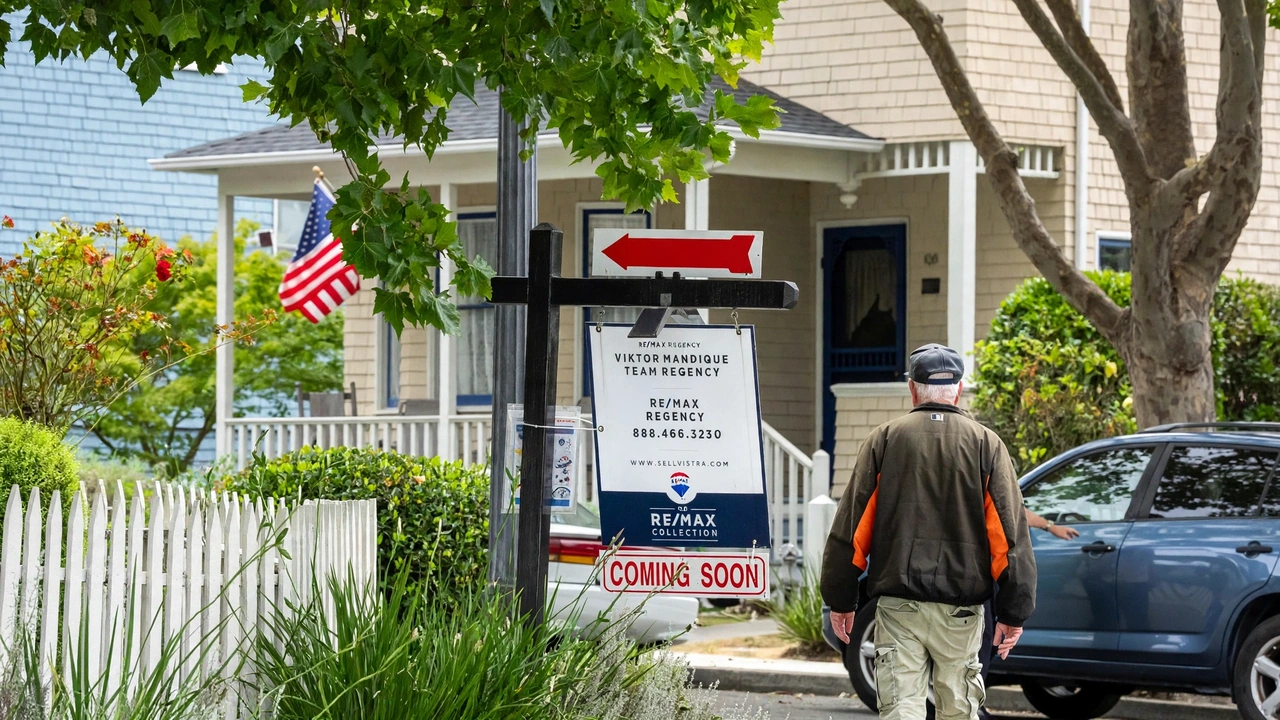
Mortgage Rates Fall Again. Why Are Buyers Still Holding Back?
Mortgage rates have fallen for three consecutive weeks, offering some relief to Americans hoping to buy a home. But the housing market is sending a different message: borrowing is getting slightly cheaper, yet buyers are still reluctant to commit to one of the biggest financial decisions of their lives.
The average 30-year fixed mortgage rate dropped to 7.18% on November 5, down from 7.24% a week earlier, according to Freddie Mac’s latest survey. Despite that improvement, mortgage purchase applications declined 2% in the latest weekly reading, suggesting that lower rates alone are not enough to restore demand.
The problem extends beyond mortgage interest. Elevated home prices, substantial monthly payments, insurance and property taxes continue to challenge affordability, while uncertainty about future borrowing costs gives some prospective buyers another reason to wait.
Rates Are Falling Again
Freddie Mac reported that the average 30-year fixed mortgage rate declined to 7.18% for the week ending November 5, marking its third consecutive weekly decrease. The rate was 7.40% on October 15, meaning borrowing costs have fallen by 0.22 percentage points in three weeks.
The average 15-year fixed mortgage rate also declined, reaching 6.57% from 6.60% the previous week. Both figures suggest that financing conditions have improved recently, although borrowing remains significantly more expensive than it was a year earlier.
In November 2025, the average 30-year fixed mortgage rate stood at 6.22%, almost a full percentage point below the latest reading. The comparison helps explain why a modest decline today may feel encouraging without making homeownership affordable for households that were already struggling to qualify.
Borrowers following mortgage rate changes face another complication: national averages do not represent the exact rates available to individual applicants. Credit scores, down payments, loan types, discount points and lender pricing can all produce different borrowing costs.
Buyers Are Still Waiting
The latest mortgage application figures show the limits of recent rate relief. According to the Mortgage Bankers Association, total mortgage application volume fell 1.2% during the week ending October 30, even as borrowing rates moved lower.
The seasonally adjusted Purchase Index declined 2% from the previous week, while unadjusted purchase applications were 19% below their level a year earlier. Refinancing applications increased just 0.1% over the week and remained 60% below the comparable period in 2025.
The MBA’s average 30-year conforming mortgage contract rate declined to 7.30% from 7.37%, showing that borrowers were seeing some improvement before Freddie Mac published its November 5 figures. The surveys use different methods and measurement periods, but both point to a market where lower rates have not yet produced a meaningful rebound in applications.
Importantly, the latest purchase application figures cover the week ending October 30, before Freddie Mac’s November 5 reading. They demonstrate weak demand during an earlier period of falling rates, rather than proving how buyers responded specifically to the newest decline.
Home Prices Remain High
Mortgage rates are only one part of the affordability problem. The national median existing-home sales price reached $417,500 in September, an increase of 1.3% from a year earlier, according to the National Association of Realtors.
Existing-home sales rose 1.5% from August to a seasonally adjusted annual rate of 3.99 million, but remained 2.2% below September 2025. Although the monthly increase was positive, August and September were the two slowest months for existing-home sales in 2026 through September.
For prospective buyers, that creates an uncomfortable situation. A modest reduction in mortgage rates can improve monthly payments, but a home priced above $400,000 still requires substantial income, savings and financial flexibility.
New construction offers a somewhat different picture. The Census Bureau reported a median new-home sales price of $400,400 in September, down 3.9% from a year earlier, although the reported year-over-year change was not statistically significant at the agency’s stated confidence level.
Monthly Savings Are Limited
Consider a buyer purchasing a $400,000 home with a 20% down payment and financing the remaining $320,000 through a 30-year fixed mortgage. At Freddie Mac’s previous average rate of 7.24%, the monthly principal-and-interest payment would be approximately $2,181.
At the latest 7.18% average, that payment falls to approximately $2,168, a reduction of only $13 per month. Over 12 months, the immediate payment difference amounts to roughly $156, assuming the same loan size and repayment terms.
The comparison becomes more revealing against last year’s borrowing costs. At 6.22%, the same $320,000 mortgage would require approximately $1,964 per month, making today’s payment about $204 higher.
These calculations exclude property taxes, homeowners insurance, mortgage insurance where applicable, maintenance, homeowners association fees and closing costs. Actual affordability depends on the full housing payment and the household’s financial circumstances, not just the interest rate displayed in a lender’s advertisement.
Demand Shows Deeper Weakness
Weak demand is also visible in housing contracts, not just loan applications. The National Association of Realtors reported that pending home sales dropped 7.3% in September from August and were 11.3% lower than a year earlier.
Contract signings declined across all four major U.S. regions, with the West recording the largest monthly decrease at 9.2%. The South followed with an 8.2% decline, while the Midwest and Northeast also experienced reductions.
These September figures reflect a period when mortgage rates were rising, making them useful evidence of broader housing-market weakness rather than a direct measurement of November’s rate decline. They nevertheless show why several weeks of improving financing conditions may not immediately reverse the slowdown.
Buyers may need time to regain confidence, reassess household budgets or find properties within their price ranges. Seasonal housing patterns, local inventory and differences between sellers’ asking prices and buyers’ budgets can also affect contract activity independently of mortgage rates.
More Homes, Fewer Deals
A slower housing market does not necessarily mean buyers have fewer choices. Existing-home inventory reached 1.60 million properties in September, up 1.9% from August, representing approximately 4.8 months of supply at the prevailing sales pace.
That increase may give qualified buyers more opportunities to negotiate, especially in areas where properties remain listed for longer. Yet expanding inventory does not automatically make homes affordable if sellers are unwilling to reduce prices enough to offset elevated financing costs.
The distinction matters because the housing market is not uniform across the country. A buyer in a market experiencing price reductions may encounter substantially different conditions from someone searching in a neighborhood where desirable properties remain scarce.
Local expenses can change affordability as well. For example, rising insurance costs can increase the total monthly obligation even when a buyer secures a slightly lower mortgage interest rate.
Why Buyers Remain Cautious
One explanation for the continuing hesitation is that buyers may be waiting for a larger improvement. Mortgage rates have declined since mid-October, but the latest 7.18% average remains above 7%, a level that can significantly restrict purchasing power for households with limited budgets.
The direction of borrowing costs also remains uncertain. Mortgage rates respond to longer-term bond yields, inflation expectations, economic conditions and the pricing decisions of mortgage lenders, rather than moving automatically with the Federal Reserve’s benchmark interest rate.
Some borrowers are responding by considering alternative financing arrangements. The MBA reported that adjustable-rate mortgages accounted for 11.4% of applications in its latest survey, the highest share since September 2025.
Adjustable-rate mortgages can offer lower initial rates, but payments may change after the initial fixed-rate period. For buyers evaluating these loans, the possibility of future payment increases matters just as much as the immediate savings.
Should Buyers Wait?
The recent declines create a genuine opportunity for households that can already afford their intended purchase. Lower mortgage rates reduce financing costs, and additional listings may improve negotiating conditions in certain markets.
However, waiting for rates to fall further carries its own uncertainty. Future borrowing costs could decline, remain elevated or increase again, while home prices and available inventory may move differently across local markets.
Buyers assessing a purchase can compare mortgage financing options using the total monthly payment rather than focusing exclusively on the headline interest rate. A realistic budget should account for taxes, insurance, maintenance, emergency savings and the possibility that refinancing may not become attractive or affordable later.
The decision is especially consequential for first-time homebuyers, who may have less accumulated home equity or savings available for a down payment. Local assistance programs and lender incentives can sometimes improve the calculation, but eligibility and actual financial benefits must be examined individually.
What Happens Next?
The next test for the housing market is whether falling borrowing costs eventually translate into more applications, signed contracts and completed sales. Weekly mortgage application figures will provide an early indication of buyer interest, while subsequent housing reports will show whether that interest becomes actual transactions.
The National Association of Realtors is scheduled to release October existing-home sales data on November 12, followed by October pending-home-sales data on November 18. Those figures will help clarify whether housing activity began stabilizing before the latest mortgage rate declines.
For now, the evidence points to a housing market where borrowing conditions are improving faster than buyer demand. Mortgage rates have fallen for three consecutive weeks, but expensive homes and still-elevated monthly payments continue to limit how much relief prospective homeowners actually receive.
The larger question is no longer simply whether mortgage rates can fall. It is whether borrowing costs and home prices can reach a combination that allows more Americans to buy without stretching their finances beyond what they can comfortably afford.