Bank Rates Today, September 3, 2026: Savings Hold Near 3.76% as Fed Hike Bets Climb
Bank rates are holding at unusually attractive levels for savers on Thursday, September 3, while a sharp change in Federal Reserve expectations is giving consumers another reason to watch savings and CD rates closely.
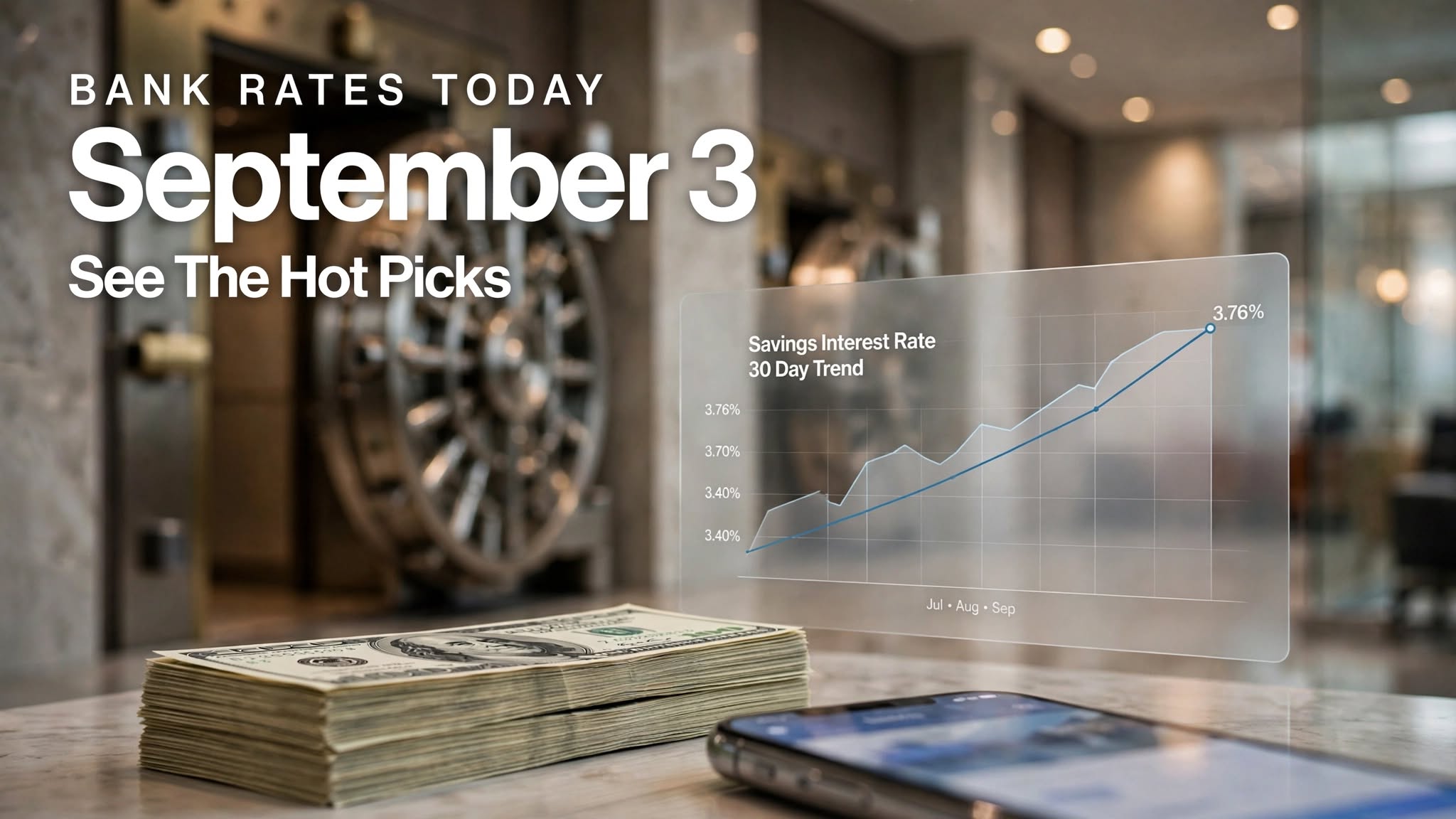
Top savings offers tracked by Bankrate are averaging about 3.76% APY today. Money market offers are around 3.49%, while featured one-year CD rates are averaging 4.12%. Those yields remain far above what many traditional savings accounts pay.The bigger story, however, is what could happen next.
Investors have rapidly increased bets that the Federal Reserve could raise interest rates at its September meeting as officials face renewed inflation pressure. Reuters reported Thursday that markets were pricing roughly a 60% chance of a September increase, with another market update putting the probability near two-thirds.
That is a major reversal from the rate-cut debate that dominated much of the earlier cycle. For savers, the shift could help keep high-yield savings and CD rates elevated for longer. It could even put upward pressure on some short-term deposit offers if banks begin expecting higher short-term interest rates. Here is the key bank-rate picture for September 3:
- High-yield savings offers tracked by Bankrate: about 3.76% APY
- Money market offers: about 3.49% APY
- 6-month CD offers: about 3.96% APY
- 1-year CD offers: about 4.12% APY
- 5-year CD offers: about 4.02% APY
- Bankrate national average savings yield as of September 2: 0.63% APY
- Federal funds target range: 3.50% to 3.75%
- September Fed hike probability in Thursday market pricing: roughly 60% to two-thirds
Bankrate says its displayed rates are averages of featured offers from institutions it tracks, so they should not be read as the single highest rate available at every bank or for every customer. Rates can also change during the day.
The spread between ordinary savings and competitive high-yield accounts remains large. A saver earning 3.76% APY is receiving almost six times the 0.63% national average measured by Bankrate. That difference becomes meaningful as account balances rise.
A $10,000 balance earning 3.76% APY would generate roughly $376 in interest over one year if the rate remained unchanged and ignoring timing differences from compounding. At 0.63%, the same $10,000 would produce about $63. That is a difference of roughly $313.
Consumers who have not compared their account recently may therefore have more to gain from shopping around than from trying to predict the Fed’s next move.
Wednesday’s bank rates report showed savings yields remaining firm even as markets wrestled with whether the Fed would tighten policy again. That question has become more important today as rate-hike expectations have strengthened. The Federal Reserve has not raised rates yet.
Its official target range remains at 3.50% to 3.75%, where policymakers left it after the July 28-29 meeting. The Fed’s official policy rate page confirms that range. At the July meeting, the decision to hold was not unanimous.
Three policymakers: Beth Hammack, Neel Kashkari and Lorie Logan, preferred a quarter-point increase. That split matters now because inflation risks have again become a major focus for financial markets. The next scheduled Fed decision is expected after its September 15-16 meeting.
Markets have moved toward a possible hike following stronger concern about inflation and energy costs. Reuters reported that expectations for a September increase had climbed sharply after Fed Chair Kevin Warsh’s recent remarks and renewed pressure from high oil prices.
The Fed’s latest Beige Book also found that U.S. economic activity edged higher while prices continued to rise moderately, leaving policymakers with a difficult mix of inflation pressure and softer areas of the economy.
The official Fed statement from July said inflation remained above the central bank’s 2% goal and specifically noted supply shocks and higher energy prices.
For bank customers, that matters because savings yields and short-term CD rates tend to react more directly to changes in short-term interest rates than longer-term borrowing products do.
A Fed hike does not guarantee that every bank will immediately raise its savings APY. Banks set their own deposit rates based on funding needs, competition and other factors.
But a higher federal funds rate can give banks more room to offer attractive yields, particularly online banks and institutions competing aggressively for deposits.
That means savers should not assume today’s rates are about to disappear simply because yields have already declined from earlier peaks. Consumers deciding between savings and CDs face a different question.
A high-yield savings account generally gives easier access to cash while its rate can change at any time. A CD normally locks the rate for a fixed period but can carry an early-withdrawal penalty. Today’s rate comparison is notable because featured one-year CDs are paying more than featured savings accounts:
- Savings: about 3.76% APY
- 6-month CD: about 3.96% APY
- 1-year CD: about 4.12% APY
- 5-year CD: about 4.02% APY
That makes the one-year part of the CD market especially interesting for savers who know they will not need their money immediately. People worried about locking all their cash at one rate can also split deposits across several maturities. Investozora’s comparison of a CD ladder and high-yield savings explains how the two approaches differ for short-term cash.
Recent CD rates have also become more important as expectations for Federal Reserve policy change. A CD allows a saver to lock an APY even if market rates later fall, while a savings account’s APY can be changed by the bank.
There is also no need to chase an unusually high advertised rate without checking the details. Before opening an account, consumers should look at:
- APY, not only the stated interest rate
- Minimum opening deposit
- Minimum balance needed to earn the advertised APY
- Monthly account fees
- Withdrawal rules
- CD early-withdrawal penalties
- Whether the bank is FDIC insured
- Whether a credit union carries equivalent federal insurance
- Whether a promotional APY expires
- Whether the advertised rate applies only to part of the balance
Deposit insurance is especially important when comparing lesser-known online institutions. The FDIC explains that deposits at an insured bank are generally covered up to at least $250,000 per depositor, per insured bank, for each ownership category. Consumers can confirm coverage through the FDIC before moving large balances.
Bank customers should also watch fees. A strong savings yield can lose much of its advantage if an account charges recurring fees or requires conditions a customer cannot meet. Recent changes involving bank fees make the total cost of an account worth checking alongside its advertised APY.
The next major test for rates comes from the U.S. labor market. Reuters reported Thursday that investors were waiting for Friday’s employment report because a weak jobs reading could reduce confidence in a September hike, while stronger data could leave the Fed with more room to focus on inflation.
Treasury yields also eased Thursday after their recent surge, showing how quickly market expectations are moving ahead of the jobs data. For savers, the practical decision is simpler than predicting the Fed.
Competitive deposit rates remain available today. Someone earning close to zero in an old savings account does not need to wait for the September Fed meeting to compare alternatives. The key numbers to watch now are:
- 3.76%: featured high-yield savings APY
- 3.49%: featured money market APY
- 3.96%: featured 6-month CD APY
- 4.12%: featured 1-year CD APY
- 4.02%: featured 5-year CD APY
- 3.50%-3.75%: current Fed target range
- About 60%-67%: range of September hike probabilities reported by Reuters Thursday
The shift in Fed expectations also follows the central bank’s tougher inflation message at Jackson Hole, which is covered in Investozora’s Fed outlook report.
Bank rates today are therefore sitting at an unusual crossroads: savings yields remain strong, one-year CDs are above 4% among featured offers, and financial markets are now treating another Fed hike as a serious possibility.
For consumers, that means there is little reason to leave large cash balances earning a very low rate. The bigger choice is whether to keep money flexible in high-yield savings or lock part of it into a CD before the Fed’s next decision.
Friday’s jobs report could move those expectations again and September’s Fed meeting could determine where savings and CD rates head next.